LEED v4 to v5: Know Before You Go
A Visual Map from LEEDv4 to LEEDv5
In our previous blog, we summarized how we prepare to transition from LEEDv4 to LEEDv5 and highlighted some of the biggest changes we’re preparing for. However, not all changes are monumental - a lot of things have stayed the same. USGBC has provided a complete detailed guide here. In this post, we’re going to focus on the new structure and prerequisite credits.
New Impact Areas and Prerequisites
LEED v5 keeps the original credit categories (i.e. Location and Transportation (LT), Sustainable Sites (SS), etc.), but reframes and centers them into new “Impact Areas” namely, Decarbonization, Quality of Life, and Ecological Preservation. This restructuring allows project teams to visualize the relationship and central issues connecting various credits. In turn, teams can make more informed decisions about which credits to pursue. Note that Prerequisites and Credits can appear in more than one impact area of which Decarbonization has the lion’s share thereof.
We are visual learners at HUSARCH and developed the following credit map showing how all the credits translate between LEED v4, LEED v5, and the new Impact areas.

Click image for detailed view
Prerequisites
A prerequisite is just as it sounds, you MUST meet these items to qualify as a LEED certified project. As we prepare for LEED v5, some have been slashed, some have been reinvented, and, exciting news, some are brand new!
Removed Prerequisites from LEED v5 Standards:
MRp2 - Construction and Demolition Waste Management Planning: this has been removed as a prerequisite, and instead will be contributing to points under MRc5 - Construction and Demolition Waste Diversion.
Reinvented Prerequisites for LEED v5 Standards:
SSp1 - Construction Activity Pollution Prevention +SSc1 - Site Assessment → SSp1 - Minimize Site Disturbance
Erosion Sedimentation Control Plan (ESCP) has always been a prerequisite, but now we update from the 2012 to 2022 EPA CGP standard. These better align with the EPA’s Stormwater Pollution Prevention Plan (SWPPP),
Previous credit, Site Assessment, has been rolled into this prerequisite. A preconstruction survey/assessment of “special-status” vegetation and protective measures is now required.
WEp1 - Outdoor Water Use Reduction + WEp2 - Indoor Water Use Reduction = WEp2 - Minimum Water Efficiency
LEED has merged indoor and outdoor water use into one prerequisite. While projects must still meet a min. threshold of 20% savings, minimum flush/flow rate requirements are much more stringent. Additional requirements for water using appliances/equipment have been added as well.
WEp3 - Building Level Water Metering → WEp1 Water Metering and reporting
In addition to potable water, projects must include analysis of “alternative water”,or basically any other water on site.
EAp1 - Fundamental Commissioning and Verification → EAp3 - Fundamental Commissioning
Standards are now updated to ASHRAE 90.1 without exceptions, CxPs are no longer allied to be a member of the design or construction team, and additional participation requirements are outlined, in other words, bring your CxP on as early as possible!
BECx testing and observation is now required. As certified BECx Providers, we’ll have a future blog dedicated to Envelope Commissioning for LEED v5!
EAp2 - Minimum Energy Performance → EAp2 - Minimum Energy Efficiency
ASHRAE 90.1 2019 is required through January 1, 2028, afterwards, it updates to the 2022 version. Future source energy can also be added to calculations and baselines have stricter requirements as well.
EAp3 - Building-Level Energy Metering → EAp4 - Energy Metering and Reporting
Energy metering is governed by ASHRAE 90.1-2019 and 2022 with the same option as Minimum Energy Performance. The updated prerequisite requires on-site renewable energy generation to be tracked separately.
EAp4 - Fundamental Refrigerant Management → EAp5 - Fundamental Refrigerant Management
Refrigerant leak checks through BAS electronic leak detectors, pressure testing, or visual inspection and subsequent repairs are now required.
MRp1 - Storage and Collection of Recyclables → MRp1 - Planning for Zero Waste Operations
LEED v5 introduces food organic waste requirements and batteries, mercury, and electric waste must all be addressed. For those of you relying on innovation credit, Purchasing Lamps, this is likely no longer an option.
EQp1 - Minimum Indoor Air Quality Performance → EQp2 - Fundamental Air Quality
Have your team take a deep breath - MERV 13 filters are now required as well as new Outside air intake considerations.
EQp2 - Environmental Tobacco Smoke Control → EQp3 - No Smoking or Vehicle Idling
LEED v5 tackles vehicle idling within the entire project site now but signage is no longer required within 10’ of all building entrances.
New Prerequisites for LEED v5 Standards
IPp1 - Climate Resilience Assessment
A comprehensive site-specific hazards assessment, (ie: extreme heat, flooding, wildfires) shall be used to identify and address two priority hazards through design. Consider companion credits: Enhanced Resilient Site Design and Resilient Spaces.
IPp2 - Human Impact Assessment
This prerequisite explores the project’s social context, drawing relevant information through demographics; local infrastructure and land use; human use and health impacts; and occupant experience. This can be a launch point for: Equitable Development, Compact and Connected Development, and Occupant Experience.
IPp3 - Carbon Assessment.
Beyond an operational carbon footprint, transportation and future emissions are now required.USGBC provided software will outline the project's estimated carbon projection for the next 25 years, based on calculations performed in EAp1, EAp5, and MRp2.
EAp1 - Operational Carbon Projection and Decarbonization Plan
This prerequisite requires four components: (1) a design analysis based on a simplified energy model or analysis from similar project or published data, (2) a site energy estimate, (3) a review of the carbon projection projection plan provided by USGBC, and (4) a Decarbonization Plan, either achieved through electrification or a 25-year period plan.
MRp2 Quantify and Assess Embodied Carbon
This new prerequisite will ask teams to assess the embodied carbon and global impacts of their material choices. A cradle-to-gate life cycle assessment must be performed for the project's structure, enclosure, and hardscape. It’s worth noting that the team’s Structural Engineer will now play a required role as the structure will be a major contributor to embodied carbon.
EQp1 - Construction Management
This prerequisite stems from the previous v4 credit, EQc3 - Construction Indoor Air Quality Management and requires an Indoor Air Quality Management plan.
Key Takeaway: LEED v4 persuaded teams to analyze their project impacts early on - LEEDv5 now requires it. Four credits have transferred to prerequisite status, and several credit strategies are now requirements. With tag words like “assessment”, “management”, and “fundamental” in many of our v5 prerequisites, teams are required to have a compiled understanding of their project impacts in decarbonization, quality of life, and ecological preservation.
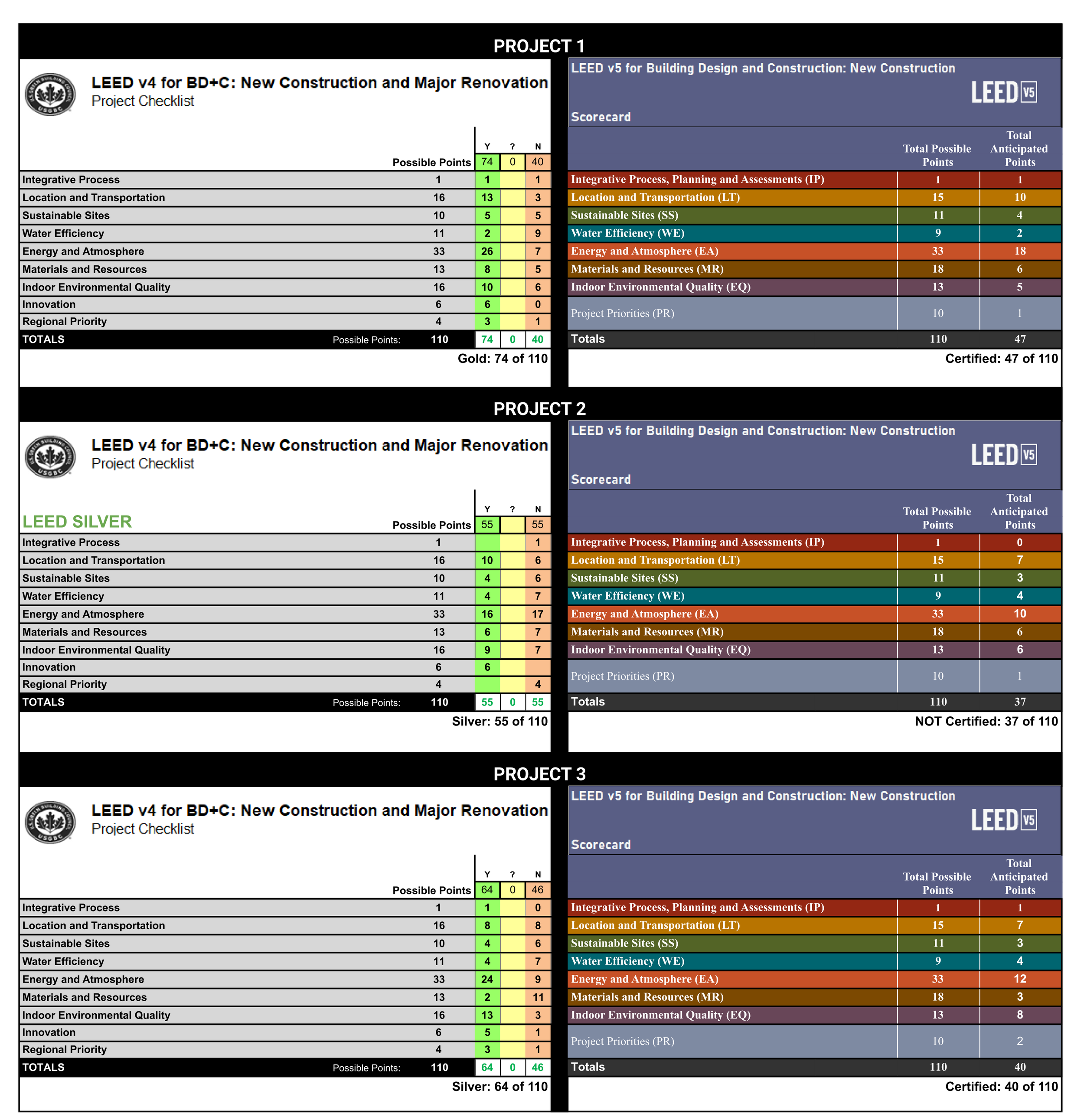
Project Comparison: LEED v4 on left, LEED v5 on Right
How do LEEDv4 projects perform in LEEDv5
We wanted to see how our recent projects would stack up to new LEED v5 standards. Unfortunately, none of these projects meets the new prerequisites, but that aside, here are how they compare:
Project 1 - LEED Gold, 74 Points to LEED Certified 48 points.
Project 2 - LEED Silver, 55 points to NO LEED certification, 37 points.
Project 3 - LEED Gold, 64 Points to LEED Certified 40 points (phew!)
Our main takeaways:
Optimized Energy Performance no longer provides a primary credit base
Previously popular Pilot Credits and Innovation Credits have been incorporated into the base credits - we will have to come up with some new strategies and keep evolving.
With points shaved off every other category, Water Efficiency and Materials & Resources are the only categories where we see consistency in total points from v4 to v5. Although BPDO credits are harder to achieved, the LEM credit makes up for it, by making a switch from EQ to MR.
Keep an eye out for our next post in this series.

About HUSARCH
For more than 15 years and nearly 2 million sf of LEED certified spaces, our team has supported architects, contractors, and owners through the LEED process for both Design & Construction.
With our specialty in LEED administration, we translate requirements into clear action items, we help you build systems that support teams during construction, and we keep projects on track to achieve any desired LEED certification from pre-design through post-occupancy.
We’ve guided teams through the transition from LEED v2009 to LEED v4 and are excited to build upon our experience through this upcoming transition to v5.
Reach out if you need any assistance in your LEED transition, if you have any questions, or you’d like to request a blog topic!